

From remarks originally presented at Benedictine College’s 15th Annual Symposium on Transforming Culture in 2026.
In 2012 the hip-hop duo Macklemore & Ryan Lewis released their debut album The Heist featuring the wildly successful song “Thrift Shop.” The lyrics tell of Macklemore’s esteem for going to thrift shops and saving money rather than flaunting expensive items. In the song, the rapper claims to enjoy donning “your granddad’s clothes” and describes impulsively buying a sharp-looking but strong-smelling fur stole just because “it was 99 cents.”
The song was a massive hit.
The song came directly in the wake of the Occupy Wall Street movement, which largely resulted from public distrust in the private sector during the aftermath of the Great Recession. The Occupy movement, as you might recall, featured large tent encampments in New York City, Washington, DC, and throughout the country in protest of wealth concentration and greed.
This political uprising also coincided with the global “hipster” phenomenon which showcased vintage sartorial irony as a critique of consumption.
Enter Macklemore and “Thrift Shop.”
However, this newfound appreciation for so-called thrift did not appear overnight. Some may also recall the band The Strokes, who in many ways launched and defined this indie-sleaze look with their disheveled, retro-cool, aesthetic. The Strokes, whose members met at posh Swiss and Manhattan boarding schools, became icons of the hipster scene (ironically, before it was even cool) and ignited debates about privilege and authenticity with the release of their 2001 EP Modern Age.
Every age has its challenges, and pride manifests itself differently at various times and places, but the top challenge of the present age, I would argue, can be found in wealth.
Globally, the period around the year 2000 saw peak global economic inequality, comparable to any age in world history, with extreme concentration in the richest 10% of the population. Nearly a quarter century removed from this point, and the gap still remains. The divide between haves and have nots has never been larger.
And yet, across the board, this entire generation also has more stuff than any other generation in history.
One often cited statistic claims the average US household contains around 300,000 individual items. I’m not sure who counted all those things, but we also know that one in three Americans currently use self-storage units, covering over 2.1 billion square feet as of 2026, and with a stronger orientation toward longer stays and larger units.
What is more, this increase in stuff also coincides with a strange and pervasive anxiety regarding all kinds of material insufficiencies.
Now it is not my purpose here to address income inequality or standards of living, but merely to propose a practical response to consumption, and particularly a response as it relates to the cultivation of beauty, or man’s declining ability to appreciate it.
In the middle of last century, Josef Pieper argued that our “ability to see is in decline” due to a bombardment of visual noise preventing man from beholding the deeper meaning of creation and human existence. While this challenge still remains, let’s add to it something we might call “the noise of superfluous possessions” or, perhaps, “the moral challenge of abundance.”
Thrift may not be a virtue commonly preached these days, and as with Macklemore it is often misunderstood, and often comically so, but it may be worth considering in this context.
Thrift, as we’ll see, is the moderate middle ground between too much and too little, and where with regard to wealth man is most at ease within himself. Neither proud of his material security, nor flaunting his sleaze.
Is it any wonder we can feel empty today before genuine works of art and even before our neighbor? In a period of abundant possessions, so many still struggle to negotiate the proper use of goods, and often wind up feeling envious and resentful. Lost in their ordinary lives. Perhaps even falling prey to a sort of financial nihilism.
Thrift addresses this, and is a practical response to one of the biggest challenges of our day and prepares one to see more clearly.
In the context of St. Thomas Aquinas, thrift is understood not as saving money, but as a component of temperance that involves the wise, moderate, and responsible management of material resources. It is temperance with regard to quantity of possessions.
Here I’ll make four points about thrift:
Thrift aims at cultivating contentment with what one has, ensuring that material possessions are treated as temporary means rather than as ultimate ends.
Thrift is distinct from poverty. Thrift entails living within one’s means, regardless of the amount at one’s disposal, whereas poverty is often a condition of lacking even essential and necessary items.
Thrift is closely aligned with generosity. Far from being miserly, thrift is practiced in order to ensure one has the resources to be generous to others.
Lastly, thrift is linked to prudence, requiring that one uses resources judiciously to avoid waste, lavishness, or unnecessary expenses. It is the opposite of impulsive.
Here, interestingly, Aquinas points out that thrift is especially relevant for judges, who by living thrift are predisposed to judge righteously.
A question worth considering, has anyone else noticed a general decline in good judgement in our society, even while access to abundant comforts, information, and ample free time should have provided the opposite?
Thrift is not about lowering one’s standard of living, or even about crafty attempts to raise it surreptitiously, but about properly ordering the goods under one’s dominion. In short, thrift is the meeting point of wealth’s divide, where moderation and taste are cultivated.
So, practically speaking, how should thrift be lived? To this we can look at two saints as examples.
In another age of stark economic inequality, 16th century Rome, St. Philip Neri provides a beautiful example of thrift properly lived.
Here I’ll quote at length from one biographer of Neri who says:
Practical commonplaceness was the special mark that distinguishes his form of ascetic piety from the types accredited before his day. He looked like other men...He was emphatically a modern gentleman, of scrupulous courtesy, and sportive gaiety, acquainted with what was going on in the world, taking a real interest in it, giving and getting information, very neatly dressed, with a shrewd common sense always alive about him, in a modern room with modern furniture, plain, it is true, but with no marks of poverty about it – in a word, with all the ease, the gracefulness, the polish of a modern gentleman of good birth, considerable accomplishments, and widespread knowledge.
In Neri one sees a thrift which is not dour or ironic, but modern, clean, and attractive. Humanly speaking, thrift is a very attractive quality even when one has very little. And St. Neri was known for his joy, he is the patron saint of comedians.
In this context it might be added that Neri was also a supporter of the composer Palestrina. And Neri arranged for popular concerts in churches around Rome to accompany his preached sermons. Thrift is perfectly comfortable and at home with great art, and often finds ways to make life just a bit more charming.
Neri, one might say, was a man adjusted to his complex world, and in many ways stood out most of all, simply by being rather ordinary.
To give a second and more contemporary example of this virtue being lived, at his canonization in 2002, Pope St. John Paul II referred to St. Josemaria Escrivá as the “saint of the ordinary.”
According to a recent study of Escrivá, thrift is an essential characteristic of his life, and to be sure, the saint writes extensively on this particular subject. As a young adult during the Spanish Civil War, Escrivá was accustomed to making due with little, or even without, his life depended on it.
In his most popular book The Way, for example, Escrivá writes, “Don’t forget it: he has most who needs least. Don’t create needs for yourself.”
And as with Neri, for Escrivá, going with less has nothing to do with miserliness. He writes:
The detachment that I preach, after looking at our Model, is lordliness; not clamorous and striking poverty, a mask of laziness and abandonment. You should dress according to the tone of your condition, your environment, your family, your work...like your companions, but for God’s sake, with the desire to give an authentic and attractive image of the true Christian life.
For Escrivá, holiness consists chiefly in shaping one’s use of goods with the will of God. This entails an artful and supple molding of the materials of daily life according to the different circumstances of each individual, regardless of the amount under their control.
In a word, Escrivá preaches elegance.
Again he writes (and with particular regard to families):
Let each one live fulfilling his vocation. For me, the best model of thrift has always been those fathers and mothers of large and poor families, who go out of their way for their children, and who with their effort and perseverance - often without the voice to tell anyone that they are in need - bring their children up, creating a joyful home in which everyone learns to love, to serve, to work.
For Neri and Escrivá, men both fully engaged in their world, thrift is an essential means by which they negotiate their divided and changing society, and actively and conscientiously participate in the cultivation of beauty, using the goods at their disposal to do what needs to be done.
To add another layer, and particularly one relating to families, economist Thomas Sowell describes with punch what can happen when this virtue is lacking. In his 2018 book, Discrimination and Disparities Sowell makes the case that lifestyle choices have major consequences.
Using the example of the American welfare state, Sowell writes:
However much the prevailing social vision may have aimed at creating a society that acts much as a family does in nurturing and protecting its members, what it has in fact done is replace the reciprocal obligations among members of a family with unilateral and unconditional subsidies…freeing the recipient from reciprocal duties, even the duty of common decency…The track record of what has happened to people stripped of personal responsibility and purpose in their lives is very sobering, at best. Many of the beneficiaries of the welfare state have sought to fill the void with drugs, sex, violence and other self-indulgences, or joining in mob rampages over the grievance du jour.
The outcome of abundance is less than beautiful.
While the American welfare state has sought to subsidize inequality, simply having more fails to address the character component of economic management, and can even compound inequality and misery.
Living on less so as to provide for others is key, and really does have repercussions. And as with the Occupy Movement it is increasingly clear that the political process has failed to sufficiently address the economic crises we see around us, and even within ourselves. This is an obligation we ourselves must champion.
To put it into stronger relief, this idea is perhaps most apparent in another of life’s great amusements, lottery winners. Nothing is more comic (or tragic) than when an ordinary person wins the lottery and splurges on a yacht and a hot tub, only to wind up broke and dejected a few years later. This is a farce of wealth, and a caricature of good taste.
To give another perspective on our topic from literature.
Given concerns about increasing wealth and technology in the 20th century, I think it’s not accidental that J.R.R. Tolkien began his epic literary work with a parable of a simple Hobbit’s confrontation with a gold hoarding dragon.
Yes, it’s a basic question, but we might ask ourselves…Why do dragons guard gold?
It’s not random — but, an ancient economic metaphor.
English linguist Dr. Colin Gorrie explains:
In warrior societies, wealth needed to flow freely — binding kings to warriors. Dragons are a symbol of the system breaking down.
The Norse story of Fáfnir captures this evolution: Once a man or dwarf, Fáfnir seizes a treasure hoard. When he refuses to share any of it, he physically transforms into a dragon. His body literally changes to match his hoarding behavior. The moral is clear: hoarding wealth doesn’t just make you LIKE a dragon — it turns you INTO one.
So dragons weren’t just scary monsters to fight — they could also represent the very human failing of greed. This explains why dragon-slaying became the ultimate heroic deed. Heroes who defeat dragons don’t just slay a monster — they restore economic order. They release hoarded wealth back into circulation, allowing society to function again.
Dragons are a 21st century problem too!
Wealth and possessions are a dragon. Perhaps we ourselves at times are even dragons unaware! Terrifying leviathans, doomscrolling in our caves, hoarding our goods, our time, our attention, turning ever inward on ourselves and on our own security.
A dragon’s den is no place for great art.
So, what can be done?
No, the answer isn’t to give it all up and turn monk.
We must think bigger. Great wealth is needed to do great things.
Let us turn our attention to perhaps the greatest work of art in history, and one which interestingly also takes place in a cave, the nativity.
What is the price of admission to see this masterpiece?
Nothing extra.
The poor shepherds are the first to see Him and are invited by all of the heavenly host. Later the Magi, elegant indeed, offer the precious gifts appropriate to their state in life. This cave is the meeting point of inequality, high and low. The moderate middle ground between too much and too little. And all is calm.
But we cannot see it ourselves unless we are detached from the superfluous.
The problem of wealth isn’t about having more, the majority have enough, it’s about making due with what is necessary and learning how to employ abundance. This noise of superfluous possessions limits the ability to see the essential.
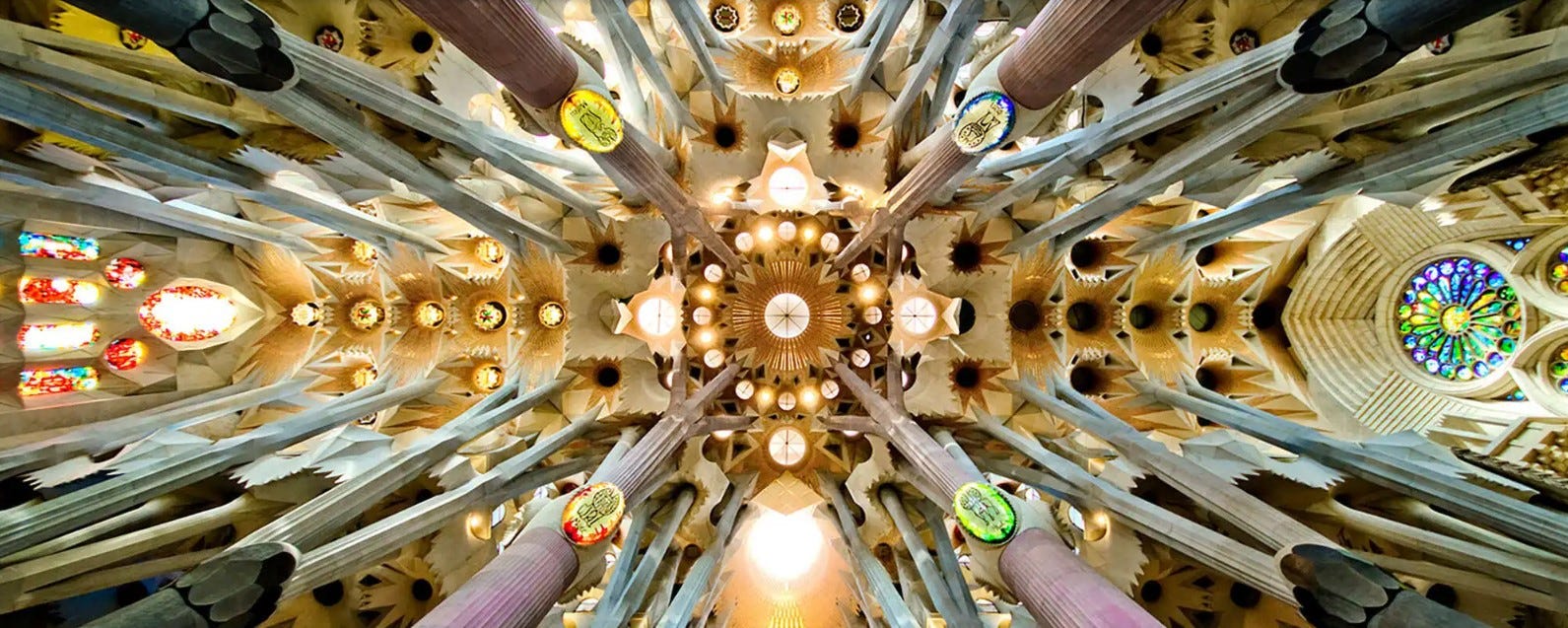
This view may also be what led Antonio Gaudi to embrace a life of conspicuous austerity in the building of his so-called “cathedral of the poor,” La Sagrada Familia, or in English, The Holy Family. His detachment from goods more easily helped him, and his city, to focus on the essential.
It’s also no wonder why the “starving” artist is a common trope. Detachment is necessary. Though it’s a virtue that must be lived first of all on the interior.
This detachment I’ve described must be complete and heroic, as nothing less than the entire power of the modern world is working against it. But to be effective, both for us and for others, it must not be odd or showy. To draw those around us to appreciate the benefit of living with less, we must practice an attractive kind of thrift that aims at liberation rather than reduction. Cultivating taste over quantity.
For many this will be expressed wearing ordinary suits and ties, though perhaps only a few ties and a few well-fitting suits. Or perhaps eating out, if possible, but at thoughtfully selected restaurants. What’s needed is a moderation that is clean and attractive, not impulsive or flamboyant, to reshape our vision. Thrift is a simple, unassuming, elegant kind of love, lived according to each person’s unique circumstances, which when practiced, settles the mind from distraction, and the superfluous noises which bombard our existence, and focuses it on just the essential.
Of course, one must be adjusted to the world while not being consumed by it, true thrift remains a kind of contradiction, since as C.S. Lewis reminds us in his commentary on this kind of love, “You can’t really be very well “adjusted” to your world if it says you “have a devil” and ends by nailing you up naked to a stake of wood.”
To conclude, billionaire Elon Musk has been known for suggesting that the funniest or most ironic scenario is often the one that comes to pass. This axiom has popularly been named, “Musk’s Razor” and he has often referred to it as a personal guiding principle.
Therefore, in our attempt to reclaim our vision, wouldn’t the funniest thing ever be for people around the world to forget themselves and their extras, if only to some modest extent, and to put their excess into edifices, works, and even schools in order to showcase not their own glory and abundance, but the glory of God and his sovereignty over man?